
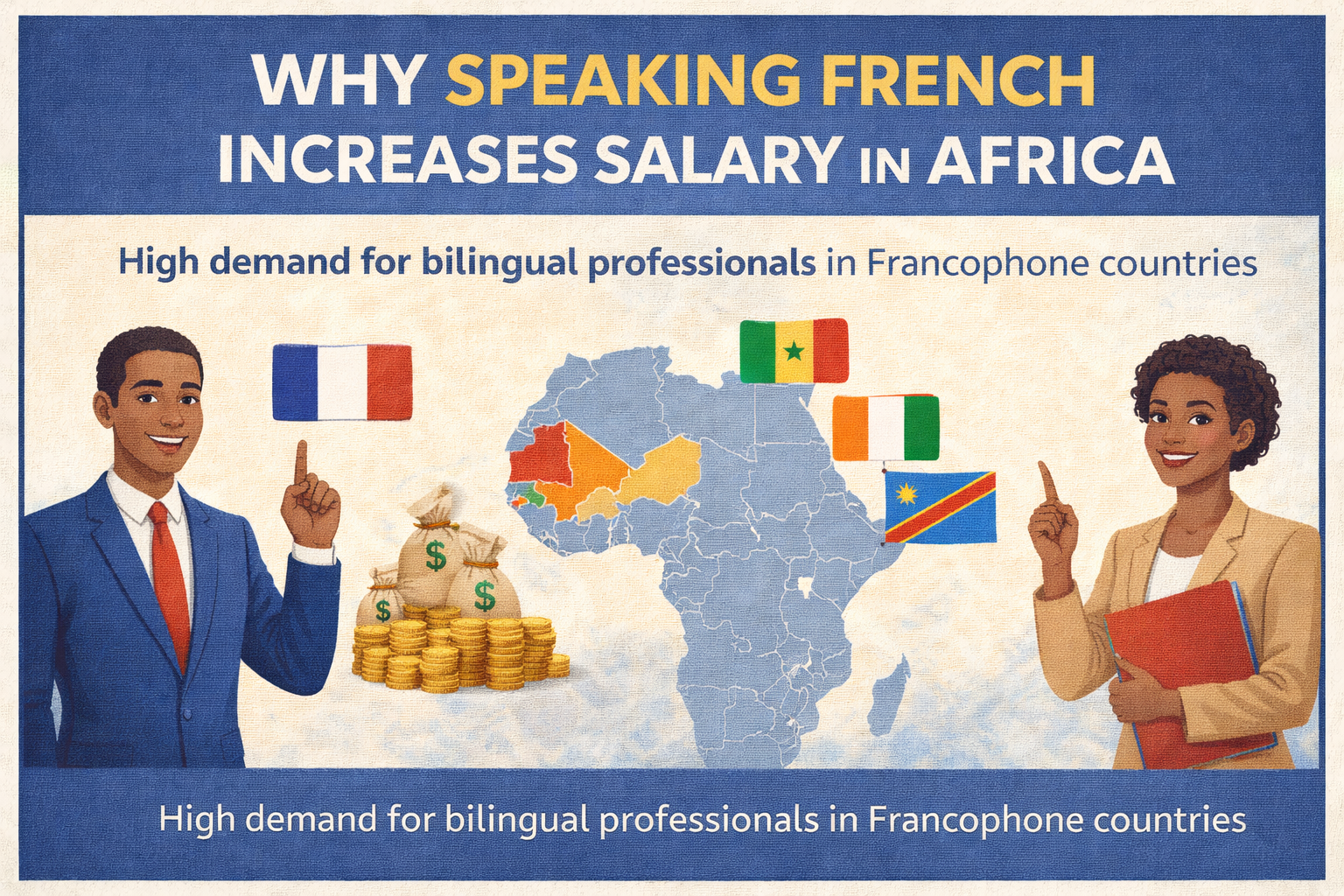
Africa is one of the fastest-growing economic regions in the world, and language plays a powerful role in shaping career opportunities across the continent. Among all foreign languages, French holds a unique and strategic position in Africa. Spoken in more than 30 African countries, French is not just a colonial legacy—it is a business, administration, education, and diplomacy language. From multinational companies to NGOs and government institutions, professionals who speak French often earn significantly higher salaries than those who don’t. This article decodes why French boosts income levels in Africa, how it creates high-paying roles, and why global employers actively seek French-speaking professionals on the continent.
French as the Official Language of High-Growth African Economies
French is an official or co-official language in over 20 African countries, including Ivory Coast, Senegal, Cameroon, DR Congo, Benin, Burkina Faso, Mali, Niger, Chad, and Rwanda. Many of these countries are experiencing rapid GDP growth, infrastructure expansion, and foreign investment. Government jobs, public-sector contracts, legal systems, and official documentation are primarily conducted in French.
Because of this, professionals who speak French gain direct access to higher-paying administrative, managerial, and policy-making roles. In sectors like customs, taxation, public finance, and international trade, French fluency is often mandatory. This linguistic requirement automatically narrows the talent pool, increasing demand and salaries for qualified French speakers. In practical terms, two candidates with the same technical skills—but one with French—will not be paid the same. The French speaker almost always earns more.
Multinational Companies Prefer French-Speaking Talent
Africa is a key investment destination for French, Canadian, Belgian, Swiss, and European multinational companies. Corporations like TotalEnergies, Orange, BNP Paribas, Société Générale, Bolloré, Danone, and Lafarge operate extensively in Francophone Africa. These companies conduct internal communication, reporting, compliance, and management in French.
As a result, employees who can communicate fluently in French are trusted with regional responsibilities, cross-border projects, and leadership roles. These positions come with higher compensation packages, foreign allowances, bonuses, and faster promotions. Even in non-French companies (American, Indian, Chinese), French-speaking staff are hired as regional coordinators, client managers, and compliance officers, which significantly raises salary bands. French is not treated as a “nice skill” in Africa—it is treated as a revenue-generating business asset.
French Unlocks High-Paying Sectors: NGOs, Diplomacy, and Development
Africa hosts thousands of international NGOs, UN agencies, development banks, and humanitarian organizations. Institutions like the United Nations, World Bank, African Development Bank, UNICEF, WHO, and Doctors Without Borders operate heavily in Francophone regions. French is often a mandatory working language alongside English.
Jobs in development economics, project management, monitoring & evaluation, policy research, and humanitarian coordination pay substantially more than average local salaries. Professionals fluent in French are eligible for international pay scales, overseas postings, and leadership tracks. Without French, access to these roles is limited. This is one of the biggest reasons why African professionals with French proficiency often earn 2x–3x higher salaries than monolingual peers.
French Creates Cross-Border Career Mobility in Africa
One major salary booster is career mobility, and French enables professionals to work across multiple African countries without retraining linguistically. A French-speaking professional from Senegal can easily work in Ivory Coast, Cameroon, Gabon, or DR Congo. This flexibility allows professionals to move where salaries are higher, projects are bigger, and funding is stronger.
Cross-border roles usually come with expat-style compensation, housing allowances, transport benefits, and tax advantages. Employers prefer candidates who don’t need interpreters or language training, which reduces costs and increases trust. Over time, this mobility translates into higher lifetime earnings. French essentially acts as a career passport across Africa, multiplying income potential far beyond local markets.
French as a Skill Scarcity = Higher Pay
Despite its importance, French fluency remains a scarce skill in many parts of Africa, especially in technical fields like IT, engineering, finance, aviation, supply chain, and data analysis. When a skill is rare but essential, salaries rise automatically. Employers are willing to pay more to avoid miscommunication, delays, and operational risks.
This is especially visible in customer support, travel, aviation, banking, and outsourcing sectors where bilingual (French-English) professionals earn 30–60% higher salaries than English-only candidates. In leadership roles, French often becomes a gatekeeping skill—without it, promotions stop. With it, growth accelerates.
Final Conclusion
Speaking French in Africa is not about prestige—it’s about economic power. French connects professionals to governments, multinationals, NGOs, and regional leadership roles that simply pay more. It unlocks cross-border mobility, international pay scales, and access to industries closed to monolingual workers. In a continent where opportunity is expanding fast, French acts as a salary multiplier, not just a language. For anyone aiming to build a high-income career in Africa—whether African professionals or international talent—learning French is one of the smartest financial decisions you can make.