
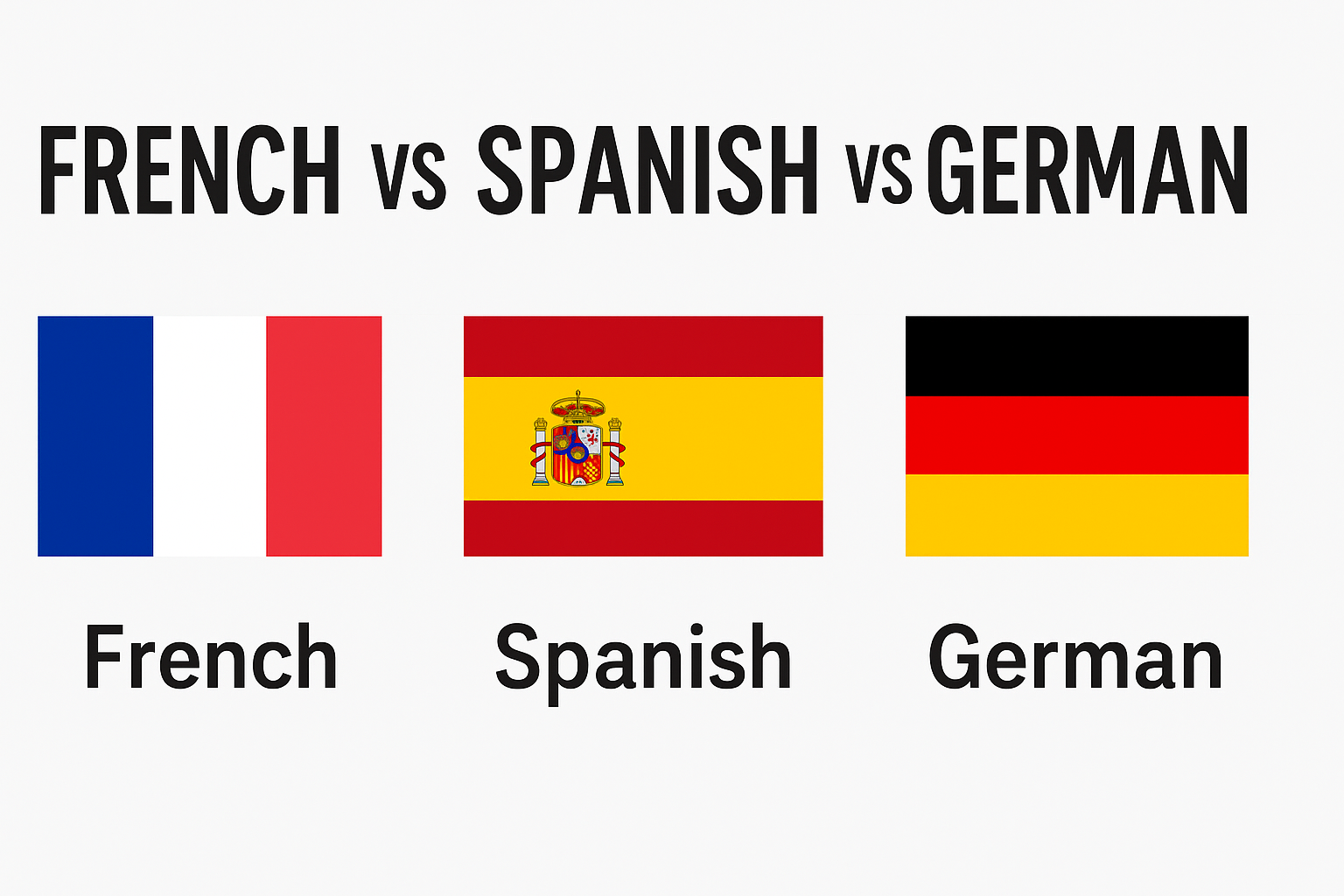
Choosing a second (or third!) language is an investment in your future — career opportunities, travel experiences, cultural exposure, and global networking. Among the most popular world languages, French, Spanish, and German stand out for their international reach, economic relevance, and cultural influence.
But the big question is: Which language should you learn?
The answer depends on your goals — professional, academic, personal, or even emotional.
This article compares French, Spanish, and German based on difficulty, career benefits, global presence, pronunciation, culture, and learning path, to help you make the best decision.
1️⃣ Global Reach & Popularity
| Language | Native Speakers | Total Speakers | Countries Spoken Officially |
|---|---|---|---|
| Spanish | ~485 million | ~595 million | 20+ countries |
| French | ~80 million | ~300 million | 29 countries (5 continents) |
| German | ~90–95 million | ~135 million | 6 countries |
✔ If your goal is travel + communication in many countries,
➡ Spanish or French are stronger.
✔ For Europe-based careers, especially in tech & business,
➡ German is often the best.
2️⃣ Difficulty Level for English Speakers
All three are quite approachable, but:
| Feature | French | Spanish | German |
|---|---|---|---|
| Grammar Complexity | Medium | Easy | Hard |
| Pronunciation | Medium-Hard | Easy | Medium |
| Verb Conjugation | Complicated | Simple patterns | Many rules |
| Gender System | Yes | Yes | Yes (plus cases) |
✔ Spanish is considered easiest for most learners.
✔ German grammar is the toughest due to cases (Nominative, Accusative, Dative, Genitive).
✔ French pronunciation and silent letters can be challenging.
3️⃣ Career & Economic Benefits
| Sector | Best Language | Why |
|---|---|---|
| Business & Finance | German | Germany = Europe’s strongest economy |
| Diplomacy, NGOs, International Relations | French | Official language of UN, NATO, UNESCO, EU |
| Tourism, Hospitality, Global Media | Spanish / French | High demand worldwide |
| Engineering & Automotive | German | HQs: BMW, Bosch, Siemens, Mercedes |
| Teaching & Translation | All 3 | Always high demand |
✔ If career ROI is the priority → German
✔ If you want to work internationally → French
✔ If you love communicating with a huge global population → Spanish
4️⃣ Culture, Media & Travel
| Interest | Best Language | Why |
|---|---|---|
| Cinema, Fashion, Cuisine | French | Parisian culture, literature, arts |
| Latin music, Telenovelas, Travel | Spanish | Spain + Latin America adventure |
| Classical music, Philosophy, Engineering museums | German | Deep intellectual heritage |
✔ Choose Spanish for energetic travel and social culture
✔ Choose French for romance, elegance, world diplomacy
✔ Choose German for innovation, discipline, precision
5️⃣ Learning Resources & Opportunities
All three languages offer:
📌 Scholarships
📌 Work visas
📌 Exchange programs
📌 Study abroad opportunities
But:
| Language | Popular Certifications | Recognition |
|---|---|---|
| French | DELF / DALF | Global government recognition |
| Spanish | DELE / SIELE | Top internationally |
| German | Goethe-Zertifikat | Highly valued in Europe |
6️⃣ Where Each Language Gives You an Edge
✔ French — Africa, Canada, Europe, Middle East
✔ Spanish — USA, Latin America, Spain
✔ German — Germany, Austria, Switzerland
7️⃣ Which One Should You Choose? – Quick Guide
| If you want… | Best Choice |
|---|---|
| Quickest to learn & most widely used | Spanish |
| Strongest career advantage in Europe | German |
| International diplomacy + 5-continent reach | French |
| Love for Romance languages & cultures | French / Spanish |
| Engineering or research careers | German |
Conclusion
There is no one best language — only the best for you.
Think about your future goals, passions, and where you want to see yourself.
- Spanish = easy + friendly + globally useful
- French = international power + cultural richness
- German = high-income careers + strong European influence
Whichever language you choose, it will open new doors and transform your perspective of the world. 🌍