
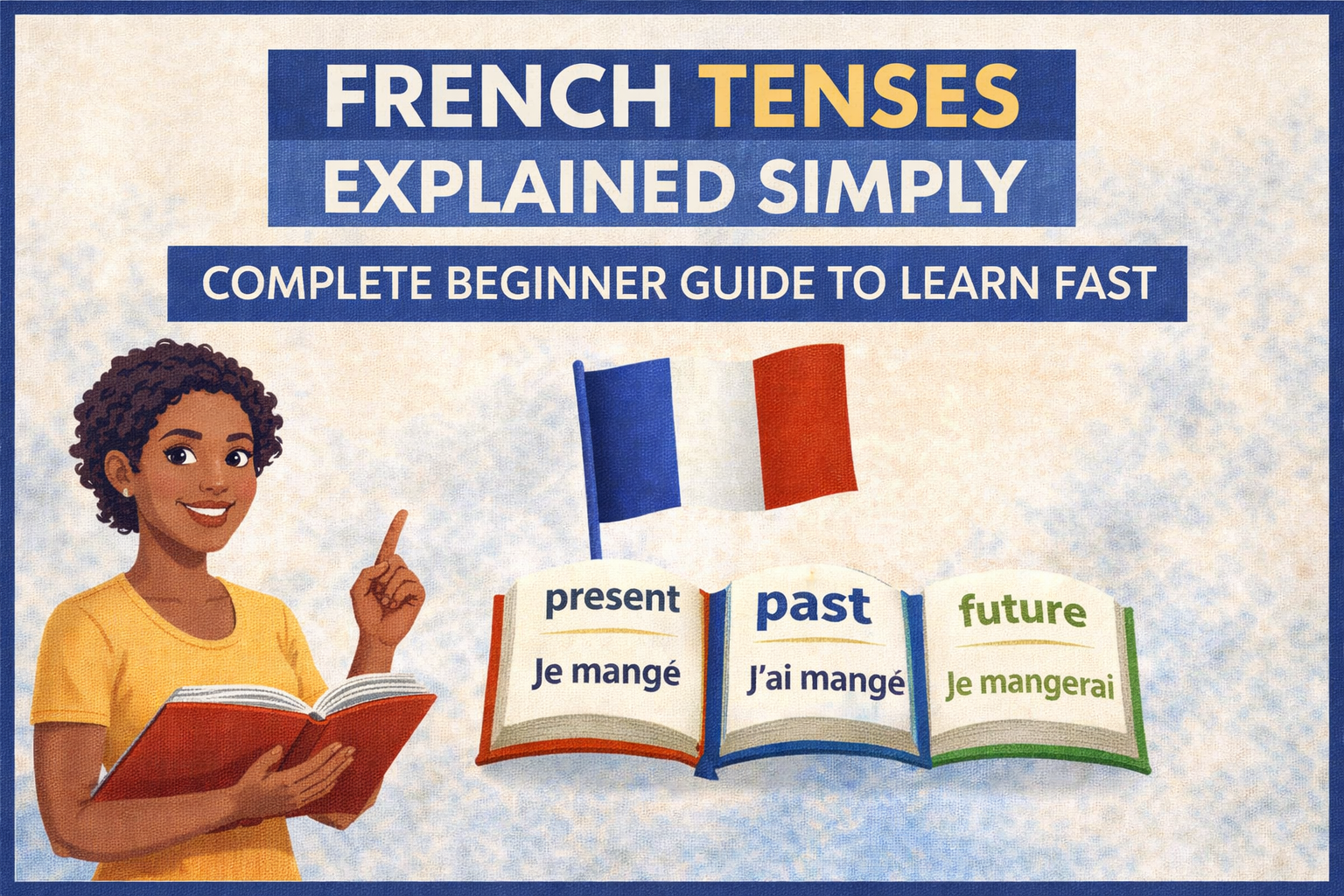
Understanding tenses is one of the most important steps in learning French. Just like in English, tenses in French help us express time—whether something is happening now, happened in the past, or will happen in the future. However, French tenses can feel more complex because they involve verb conjugation, agreement rules, and different usage contexts. The good news is that once you understand the basic structure and logic, French tenses become much easier to use in real-life conversations. For beginners, especially Indian learners who already know English grammar, French tenses can be learned faster by comparing them with English. This article will help you understand the most important French tenses, how they are used, and how you can apply them in daily communication.
Present Tense (Le Présent)
The present tense in French, known as le présent, is used to describe actions happening right now, general truths, habits, and even near-future events. It is similar to the English present simple and present continuous combined. For example, Je mange means “I eat” or “I am eating” depending on context.
French verbs are divided into three groups: -ER, -IR, and -RE verbs, and each group follows its own pattern of conjugation. For example, with the verb parler (to speak), we say: Je parle, Tu parles, Il parle. Unlike English, French requires changing the verb form for each subject.
The present tense is the most commonly used tense in daily conversation. Whether you are introducing yourself, talking about routines, or expressing opinions, this tense is essential. Mastering it builds the foundation for all other tenses in French.
Past Tense (Le Passé Composé)
The most commonly used past tense in spoken French is le passé composé. It is used to describe completed actions in the past, similar to “I did,” “I have done,” or “I went” in English.
This tense is formed using an auxiliary verb (avoir or être) and a past participle. For example:
J’ai mangé (I ate / I have eaten)
Je suis allé (I went)
Choosing between avoir and être depends on the verb. Most verbs use avoir, while verbs of movement and reflexive verbs use être. When using être, the past participle must agree with the subject in gender and number.
This tense is widely used in conversations, storytelling, and daily communication. If you want to talk about past experiences in French, passé composé is your go-to tense.
Future Tense (Le Futur Simple)
The future tense in French, called le futur simple, is used to talk about actions that will happen in the future. It is equivalent to “will” or “shall” in English.
To form this tense, you usually take the infinitive form of the verb and add specific endings. For example:
Je parlerai (I will speak)
Tu finiras (You will finish)
Unlike English, French uses one-word forms instead of adding “will” separately. This makes it more structured but requires memorization of endings.
French also uses the near future tense (futur proche), formed with aller + infinitive, like:
Je vais manger (I am going to eat)
Both forms are important. Futur simple is used in formal situations and writing, while futur proche is more common in everyday speech.
Imperfect Tense (L’Imparfait)
The imperfect tense, or l’imparfait, is used to describe ongoing or repeated actions in the past. It is similar to “was doing,” “used to,” or “would” in English.
For example:
Je mangeais (I was eating / I used to eat)
Il faisait froid (It was cold)
This tense is often used for descriptions, habits, emotions, and background information in storytelling. It does not focus on the completion of an action but rather on its duration or repetition.
One of the key differences between passé composé and imparfait is that the former describes completed actions, while the latter describes ongoing or habitual past actions. Understanding this difference is essential for speaking naturally in French.
Why Learning French Tenses Is Important
Learning French tenses is not just about grammar—it is about expressing yourself clearly and confidently. Each tense allows you to communicate different time frames, emotions, and levels of detail. Without tenses, conversations would be unclear and limited.
For Indian learners, the advantage is that English already provides a strong base for understanding tense structures. Many concepts, like past, present, and future, are similar, making it easier to grasp French grammar.
Mastering tenses also improves your ability to understand native speakers, watch French content, and perform well in exams like DELF and DALF. It opens the door to fluent communication and helps you move from beginner to advanced levels smoothly.
Conclusion
French tenses may seem challenging at first, but they follow clear patterns and logic. By focusing on the most important tenses—present, past (passé composé), future, and imperfect—you can cover the majority of real-life conversations. The key is consistent practice, understanding usage, and applying these tenses in speaking and writing. Over time, what feels complex today will become natural and automatic. Learning French tenses is not just about rules—it is about unlocking the ability to express your thoughts across time, making your communication complete and meaningful.