
A Complete Guide for French Learners
French is a language rich in small details that make big differences in meaning. One such detail is the suffix “–ci.” Though tiny, it plays an important role in making speech more precise, especially when pointing out proximity or distinguishing objects.
This article will help you fully understand the usage, meaning, and rules of the French suffix –ci, supported with examples and comparison charts.
⭐ What is the Suffix –ci?
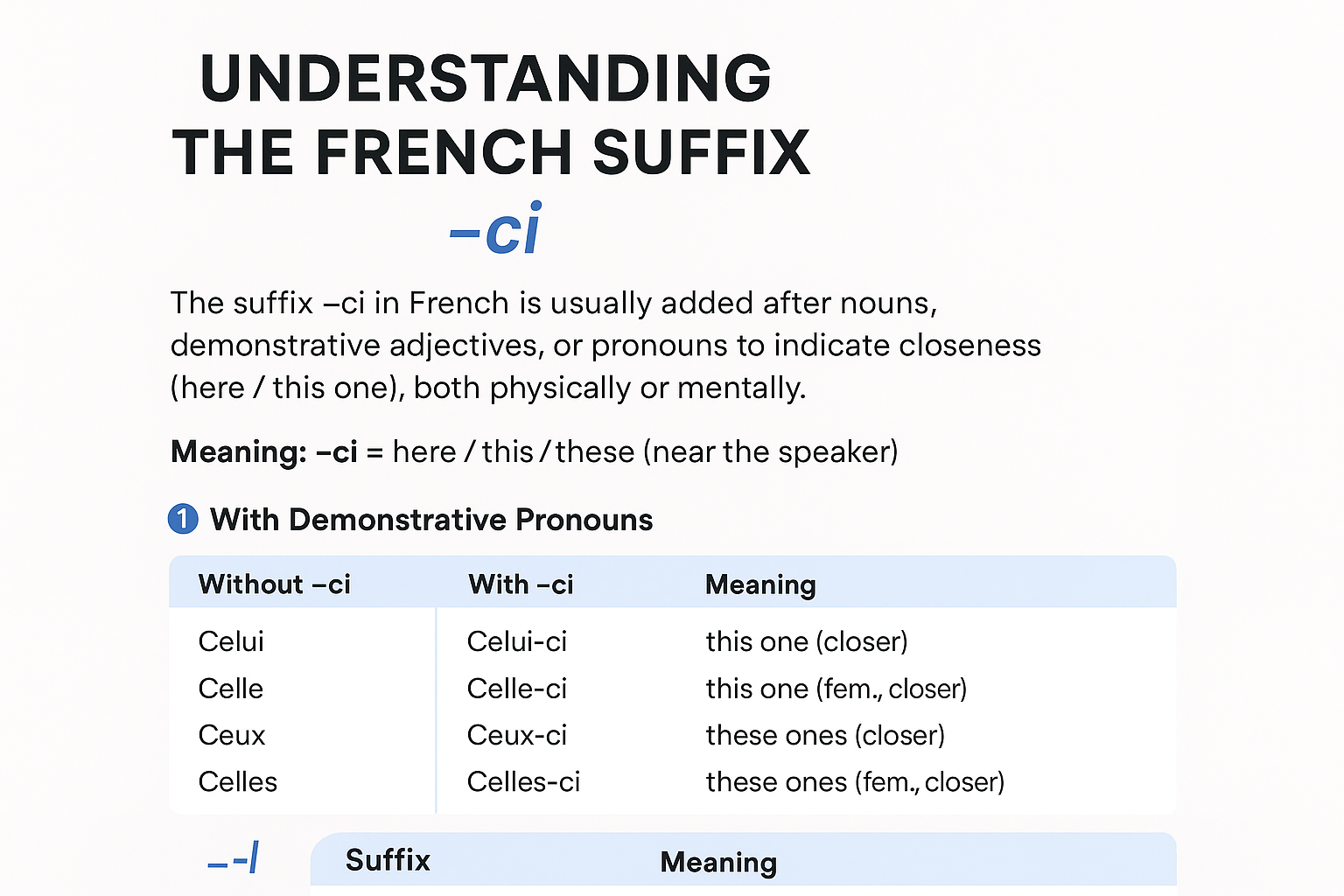
The suffix –ci in French is usually added after nouns, demonstrative adjectives, or pronouns to indicate closeness (here / this one), both physically or mentally.
📌 Meaning:
- –ci = here / this / these (near the speaker)
Example:
- Ce livre-ci → This book (right here)
- Ces chaussures-ci → These shoes (near me)
So when you see –ci, think of something close enough to point at.
🏷️ How –ci Works in French
It is mainly used with demonstrative determiners (ce, cette, ces) and demonstrative pronouns (celui, celle, ceux, celles).
1️⃣ With Demonstrative Determiners
| Demonstrative | + noun | + –ci | Meaning |
|---|---|---|---|
| ce (m. sing.) | ce livre | ce livre-ci | this book (near) |
| cette (f. sing.) | cette table | cette table-ci | this table (near) |
| ces (plural) | ces enfants | ces enfants-ci | these children (near) |
📎 Used to indicate topical proximity: “the one here, not the one there.”
2️⃣ With Demonstrative Pronouns
To distinguish between two compared objects:
| Without –ci | With –ci | Meaning |
|---|---|---|
| Celui | Celui-ci | this one (closer) |
| Celle | Celle-ci | this one (fem., closer) |
| Ceux | Ceux-ci | these ones (closer) |
| Celles | Celles-ci | these ones (fem., closer) |
🔄 Often paired with –là (meaning that one over there):
- Celui-ci = This one (near)
- Celui-là = That one (far)
3️⃣ Demonstrating Physical or Emotional Proximity
- J’aime beaucoup cette chanson-ci.
→ I love this song (the one we’re listening to now) - Ce moment-ci est très important pour moi.
→ This moment (currently happening) matters a lot to me.
🆚 –ci vs –là: What’s the Difference?
| Suffix | Meaning | Usage |
|---|---|---|
| –ci | Here / This | Nearby item or idea |
| –là | There / That | Distant item or idea |
📌 Used together to contrast choices:
- Ce stylo-ci est bleu, celui-là est noir.
→ This pen is blue, that one is black.
🎯 Advanced Usage
Used to Give Emphasis or Precision
- Ce livre-ci, not just any book, but the one the speaker holds.
- Can show affection or emotional closeness
→ Mon fils-ci (my dear son here)
❌ When Not to Use –ci
Do not use –ci with:
- Indefinite articles (un, une)
- Possessive adjectives (mon, ta, leurs)
- Proper nouns
❌ * ~Mon ami-ci~ *
✔ Cet ami-ci → this friend (who is here)
📌 Quick Summary
| Feature | –ci |
|---|---|
| Meaning | here / this |
| Use | proximity, emphasis |
| Works with | demonstrative determiners & pronouns |
| Opposite | –là = there / that |
💡 Pro Tip for Students
When confused, imagine pointing with your finger:
👉 –ci = the one I can touch
👉 –là = the one farther away
🌟 Conclusion
The suffix –ci may seem tiny, but it plays a huge role in everyday French conversation. It helps clarify meanings, emphasize proximity, and avoid confusion. Practicing it with –là will give you more natural and expressive French communication.
The more you use it, the more instinctive it becomes!