
Adverbs are small but extremely important words in French. They help us explain how, when, where, how often, or to what extent something happens. Without adverbs, our sentences may be grammatically correct but often sound incomplete or less natural. Compare Il parle français (He speaks French) with Il parle français couramment (He speaks French fluently). The second sentence gives us much more information because the adverb couramment tells us how he speaks.
French adverbs are generally easier to recognize than many other grammar categories because a large number of them end in -ment, similar to the English ending -ly. However, not every French adverb follows this pattern. Words such as très (very), souvent (often), toujours (always), ici (here), bien (well), and mal (badly) are also extremely common.
Understanding both the types of French adverbs and their correct position in a sentence is essential for speaking and writing naturally. In this guide, we will explore the major types of adverbs, how they are formed, and where they normally appear in French sentences.
What Are Adverbs in French?
French adverbs, called les adverbes, modify a verb, adjective, another adverb, or sometimes an entire sentence. They provide additional information about an action, quality, frequency, place, or degree.
For example:
Elle parle lentement.
She speaks slowly.
Here, lentement describes how she speaks.
Il est très intelligent.
He is very intelligent.
Here, très modifies the adjective intelligent.
Je travaille beaucoup.
I work a lot.
Here, beaucoup gives information about the extent of the action.
One important advantage is that French adverbs are generally invariable. This means they do not change according to masculine, feminine, singular, or plural forms.
For example:
Il parle rapidement.
He speaks quickly.
Elle parle rapidement.
She speaks quickly.
The adverb rapidement remains exactly the same. This is different from French adjectives, which often need to agree with the noun they describe.
Types of French Adverbs
French adverbs can be divided into several categories according to the information they provide.
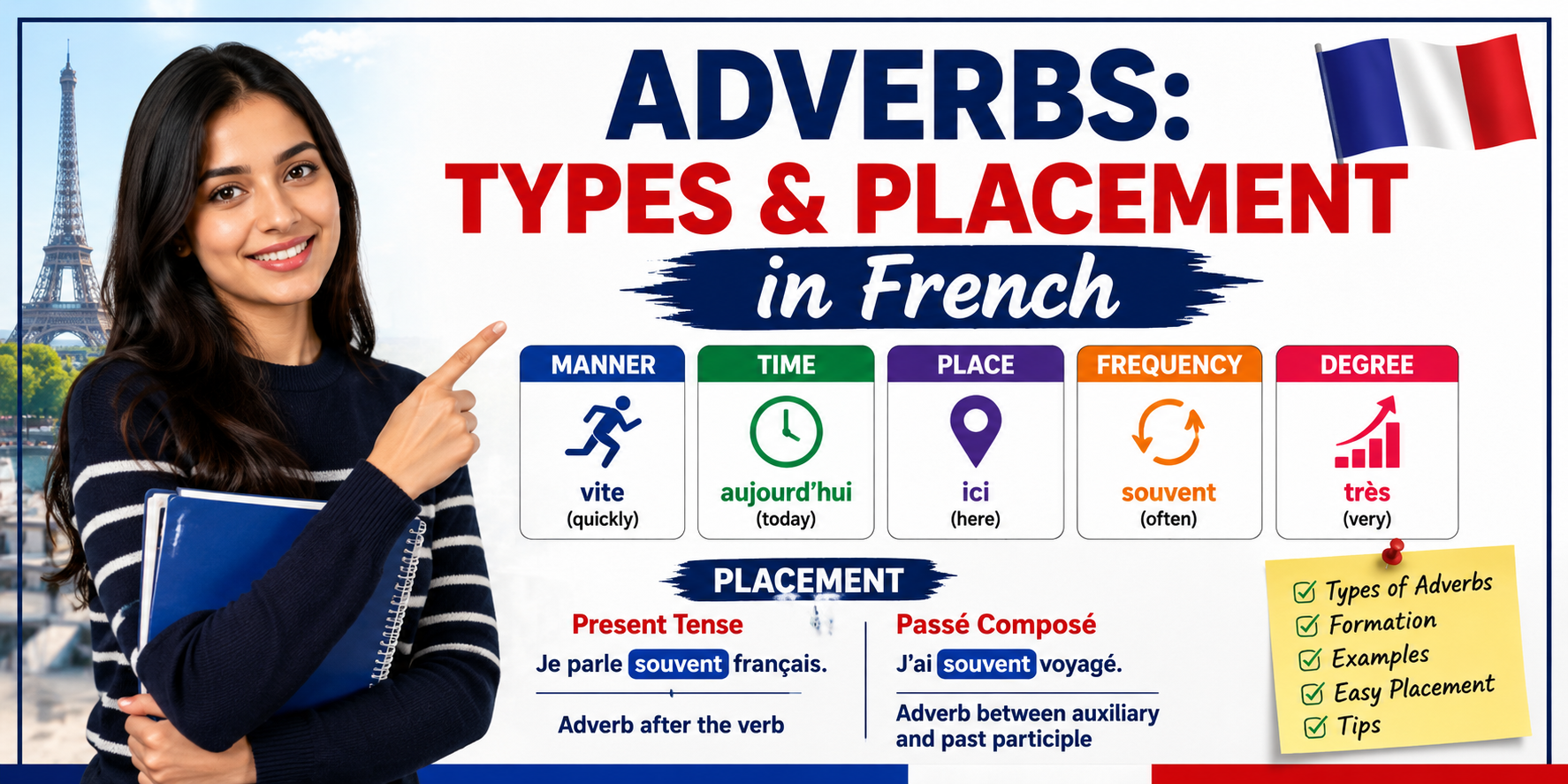
Adverbs of manner explain how an action happens. Common examples include bien (well), mal (badly), vite (quickly), lentement (slowly), and facilement (easily).
Elle chante bien.
She sings well.
Adverbs of time tell us when something happens. Examples include aujourd’hui (today), demain (tomorrow), hier (yesterday), maintenant (now), and bientôt (soon).
Je travaille aujourd’hui.
I am working today.
Adverbs of place indicate where something happens. Common examples include ici (here), là (there), partout (everywhere), ailleurs (elsewhere), and dessus (on top).
Viens ici.
Come here.
Adverbs of frequency explain how often something happens. Examples include toujours (always), souvent (often), parfois (sometimes), rarement (rarely), and jamais (never).
Je vais souvent au cinéma.
I often go to the cinema.
Adverbs of quantity or degree indicate how much or to what extent something happens. Examples include très (very), trop (too much/too), assez (enough/quite), beaucoup (a lot), and peu (little).
Elle est très gentille.
She is very kind.
These categories make it easier to understand the role of an adverb before deciding where to place it.
How to Form French Adverbs
Many French adverbs are formed from adjectives by adding -ment. This is somewhat comparable to adding -ly in English.
For many adjectives ending in a consonant, the feminine form is used before adding -ment.
For example:
heureux → heureuse → heureusement
happy → happily
lent → lente → lentement
slow → slowly
franc → franche → franchement
frank → frankly
For adjectives ending in -ant, the ending generally becomes -amment:
constant → constamment
constant → constantly
For adjectives ending in -ent, the ending generally becomes -emment:
prudent → prudemment
careful → carefully
There are also many common adverbs that do not follow the simple -ment pattern.
bon → bien
good → well
meilleur → mieux
better → better/well
beaucoup
a lot
toujours
always
Because these forms cannot always be predicted, learners should memorize frequently used adverbs as complete vocabulary items.
Placement of Adverbs in French Sentences
Adverb placement is one of the most important areas to understand because French does not always follow English word order.
With a simple present-tense verb, many short adverbs normally come after the conjugated verb.
Je travaille souvent.
I often work.
Elle parle bien français.
She speaks French well.
Nous mangeons beaucoup.
We eat a lot.
However, longer adverbs ending in -ment are also commonly placed after the verb or after the object, depending on what they modify.
Il parle lentement.
He speaks slowly.
Elle explique clairement la leçon.
She explains the lesson clearly.
With passé composé, many short adverbs are placed between the auxiliary verb and the past participle.
J’ai souvent voyagé en France.
I have often travelled to France.
Elle a bien travaillé.
She worked well.
Nous avons déjà mangé.
We have already eaten.
This position is especially common with short adverbs such as bien, mal, souvent, toujours, déjà, and encore. Longer adverbs often appear after the past participle.
Il a répondu rapidement.
He replied quickly.
Elle a parlé calmement.
She spoke calmly.
Placement can change slightly depending on emphasis and style, but these patterns provide a strong foundation for beginners.
Adverbs With Adjectives and Other Adverbs
When an adverb modifies an adjective, it usually comes before the adjective.
Il est très intelligent.
He is very intelligent.
Elle est vraiment heureuse.
She is really happy.
Cette voiture est assez chère.
This car is quite expensive.
The same principle often applies when an adverb modifies another adverb.
Il parle très rapidement.
He speaks very quickly.
Here, très modifies rapidement.
Some adverbs can completely change the meaning or intensity of an adjective. Compare:
Il est gentil.
He is kind.
Il est très gentil.
He is very kind.
Il est trop gentil.
He is too kind.
The adjective remains gentil, while the adverb changes the degree or meaning of the statement.
Learning these combinations is particularly useful because they appear constantly in everyday French conversations.
Common Mistakes With French Adverbs
One common mistake among English-speaking learners is translating English word order directly into French. Although the meaning may remain understandable, the sentence can sound unnatural.
For example, English speakers may try to place souvent exactly where they would place “often” in English. In French, the normal position is frequently after the conjugated verb:
Je vais souvent au restaurant.
I often go to the restaurant.
Another mistake is treating adverbs like adjectives. Adverbs do not normally agree in gender or number.
You say:
Elle parle rapidement.
Not:
Elle parle rapidement-e.
The form rapidement stays unchanged.
Learners should also avoid assuming that every adjective becomes an adverb simply by adding -ment. Some forms are irregular, such as bon → bien and mauvais → mal. These common words should be learned individually.
Conclusion
French adverbs may be small words, but they have a major impact on the accuracy and naturalness of your French. They allow you to explain how, when, where, how often, and to what degree something happens. The most common types include adverbs of manner, time, place, frequency, and quantity or degree.
For beginners, the most important step is to learn common adverbs together with example sentences rather than memorizing isolated vocabulary. Pay particular attention to placement, especially in the present tense and passé composé. Remember that short adverbs often appear close to the verb, while adverbs modifying adjectives usually come before the adjective.
Once you become comfortable with words such as bien, très, souvent, toujours, rapidement, ici, and déjà, your French sentences will immediately become more detailed and natural. Mastering adverbs is therefore an important step toward confident French speaking and writing.