
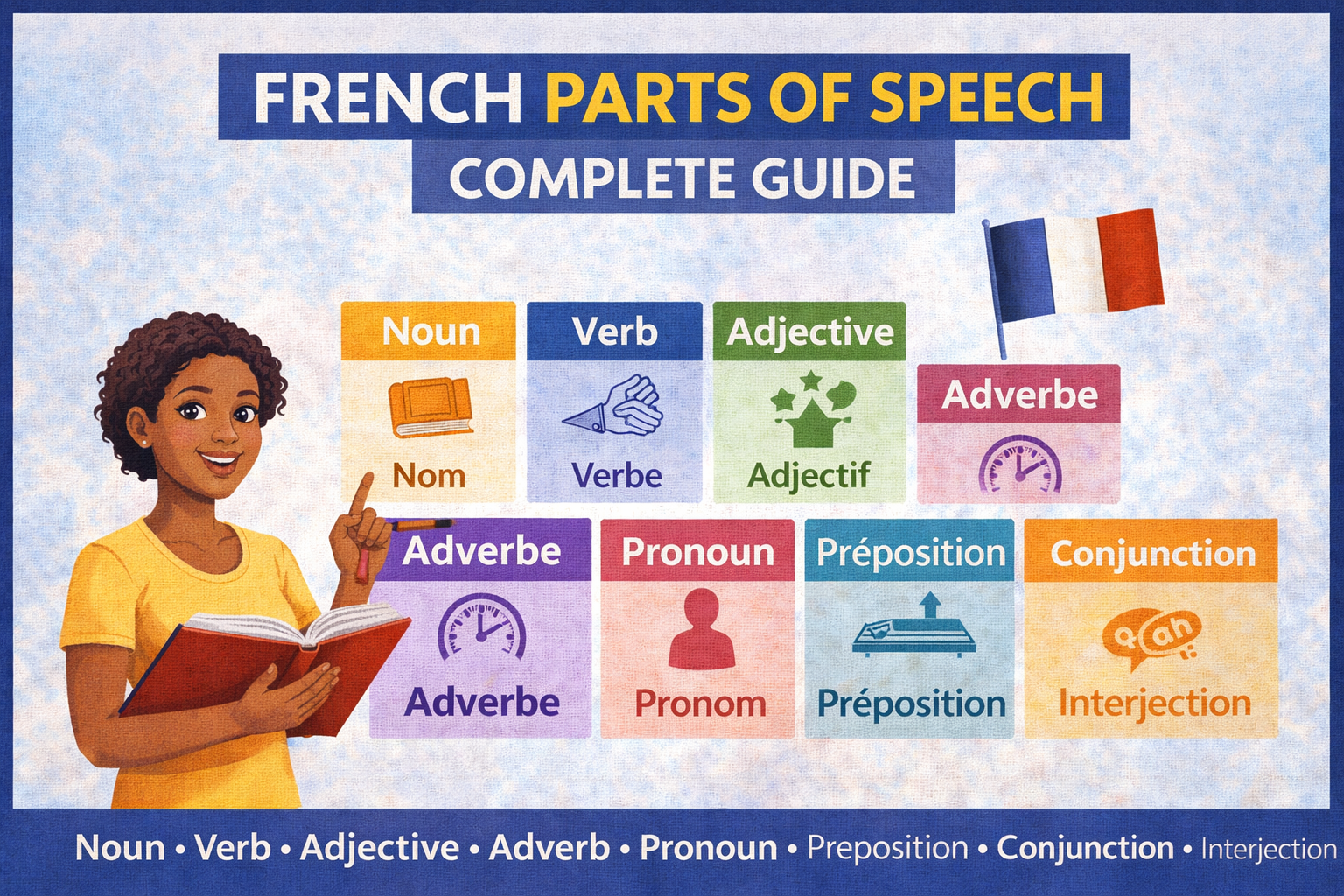
Understanding parts of speech is the foundation of learning any language, and French is no different. If you want to speak correctly, write accurately, and understand sentences clearly, you must first know how words function in a sentence. In French, each word belongs to a specific category such as noun, verb, adjective, or adverb. These categories are known as parts of speech.
For Indian learners, this concept is already familiar because English and Hindi grammar also follow similar classifications. However, French introduces additional elements like gender, agreement, and word order, which make it slightly different. Once you understand these basics, French becomes logical and easy to learn. This article explains all the major parts of speech in French in a simple and practical way so that you can build a strong foundation for communication.
Nouns (Les Noms)
Nouns represent people, places, things, or ideas. In French, every noun has a gender: masculine or feminine, which is a key difference from English. This gender affects articles and adjectives used with the noun.
Examples:
le livre (the book – masculine)
la table (the table – feminine)
French nouns are almost always used with articles like le, la, un, une. Learning nouns with their articles is important because it helps in correct sentence formation.
Plural nouns usually add “-s,” but the pronunciation often does not change. This can be confusing for beginners, so regular practice is essential. Nouns form the base of any sentence, making them one of the most important parts of speech.
Verbs (Les Verbes)
Verbs express actions or states of being. They are essential for forming sentences and conveying meaning. In French, verbs change depending on the subject and tense, which is called conjugation.
Examples:
Je parle (I speak)
Nous mangeons (We eat)
French verbs are divided into three groups:
-ER verbs (parler)
-IR verbs (finir)
-RE verbs (vendre)
There are also irregular verbs like être and avoir that must be memorized. Verbs allow you to express time through different tenses, making them central to communication.
Adjectives (Les Adjectifs)
Adjectives describe nouns and provide additional information. In French, adjectives must agree in gender and number with the noun they describe.
Examples:
un homme grand (a tall man)
une femme grande (a tall woman)
Most adjectives come after the noun, unlike English. However, some common adjectives appear before the noun. Agreement is important, and learners must adjust adjectives based on masculine, feminine, and plural forms.
This rule may seem difficult at first, but with practice, it becomes natural.
Adverbs (Les Adverbes)
Adverbs modify verbs, adjectives, or other adverbs. They describe how, when, where, or to what extent something happens.
Examples:
Il parle lentement (He speaks slowly)
Elle est très intelligente (She is very intelligent)
Many French adverbs are formed by adding “-ment” to the feminine form of adjectives, similar to “-ly” in English.
Adverbs are easier to use because they do not change based on gender or number. They are widely used in both spoken and written French.
Pronouns (Les Pronoms)
Pronouns replace nouns to avoid repetition and make sentences smoother. They change depending on their function in a sentence.
Examples:
Je (I), Tu (you), Il/Elle (he/she), Nous (we)
Object pronouns include:
me, te, le, la, nous, vous, les
Example:
Je vois Marie → Je la vois (I see Marie → I see her)
Pronouns in French are placed before the verb, which is different from English. This requires practice but is essential for fluency.
Prepositions (Les Prépositions)
Prepositions show relationships between words, such as location, direction, or time.
Examples:
à (to, at), de (of, from), dans (in), sur (on)
Example sentences:
Je vais à Paris (I go to Paris)
Le livre est sur la table (The book is on the table)
Prepositions must be memorized because their usage often differs from English. They are small words but very important for sentence clarity.
Conjunctions (Les Conjonctions)
Conjunctions connect words, phrases, or clauses. They help form longer and more meaningful sentences.
Examples:
et (and), ou (or), mais (but), parce que (because)
Example:
Je mange et je bois (I eat and I drink)
Je reste parce que je suis fatigué (I stay because I am tired)
They are essential for expressing ideas clearly and linking thoughts together.
Interjections (Les Interjections)
Interjections are short expressions used to show emotions or reactions. They are common in spoken French and add natural expression to communication.
Examples:
Oh !, Ah !, Ouf !, Aïe !, Bravo !
Example:
Aïe ! Ça fait mal. (Ouch! It hurts.)
Bravo ! Tu as réussi. (Well done! You succeeded.)
Interjections do not follow strict grammatical rules, but they are important for sounding natural in real-life conversations.
Conclusion
French parts of speech are the building blocks of the language. By understanding nouns, verbs, adjectives, adverbs, pronouns, prepositions, conjunctions, and interjections, learners can create correct and meaningful sentences. While some concepts like gender and agreement may seem challenging at first, they become easier with practice. For Indian learners, the advantage is already having a background in English grammar, which helps in understanding these concepts quickly. Mastering parts of speech is the first step toward fluency, confidence, and effective communication in French.