
When learning French, many students translate English sentences word-for-word. While this may sound logical, it often results in unnatural or incorrect French. French has its own rhythm, expressions, and sentence logic that differs significantly from English. Native speakers rarely say things the way English speakers directly translate them.
This article focuses on 10 of the most common English phrases learners try to translate literally — and shows you the correct French-style way to say them. Mastering these expressions will instantly make your French sound more natural, fluent, and confident, especially in conversations, exams (DELF/DALF), and professional settings.
1. Don’t say: “I am agree”
❌ Je suis d’accord (literal thinking error)
✅ Je suis d’accord (correct French expression)
In English, “agree” works like an adjective, but in French, agreement is expressed using a fixed expression. French uses être d’accord rather than a verb equivalent of “agree.”
✔ Example:
Je suis d’accord avec toi.
(I agree with you.)
This phrase is extremely common in daily conversations and formal discussions.
2. Don’t say: “I have 25 years”
❌ Je suis 25 ans
✅ J’ai 25 ans
French expresses age using the verb avoir (to have), not être (to be). This is one of the first mistakes beginners make.
✔ Example:
J’ai 25 ans et je travaille à Paris.
(I am 25 years old and work in Paris.)
This structure is mandatory in French.
3. Don’t say: “I am hot”
❌ Je suis chaud (means sexually aroused / motivated)
✅ J’ai chaud
To talk about temperature or physical sensations, French again uses avoir, not être.
✔ Example:
Il fait chaud aujourd’hui, j’ai chaud.
(It’s hot today; I’m hot.)
Using je suis chaud can completely change the meaning.
4. Don’t say: “I miss you”
❌ Je te manque (wrong direction)
✅ Tu me manques
French reverses the logic: the person being missed is the subject.
✔ Example:
Tu me manques beaucoup.
(I miss you a lot.)
This is one of the most emotionally important expressions in French.
5. Don’t say: “I am excited”
❌ Je suis excité (often sexual)
✅ Je suis content / enthousiaste / impatient
“Excité” in French can sound inappropriate. Choose expressions based on context.
✔ Examples:
- Je suis très content. (happy)
- Je suis enthousiaste. (enthusiastic)
- J’ai hâte de te voir. (looking forward)
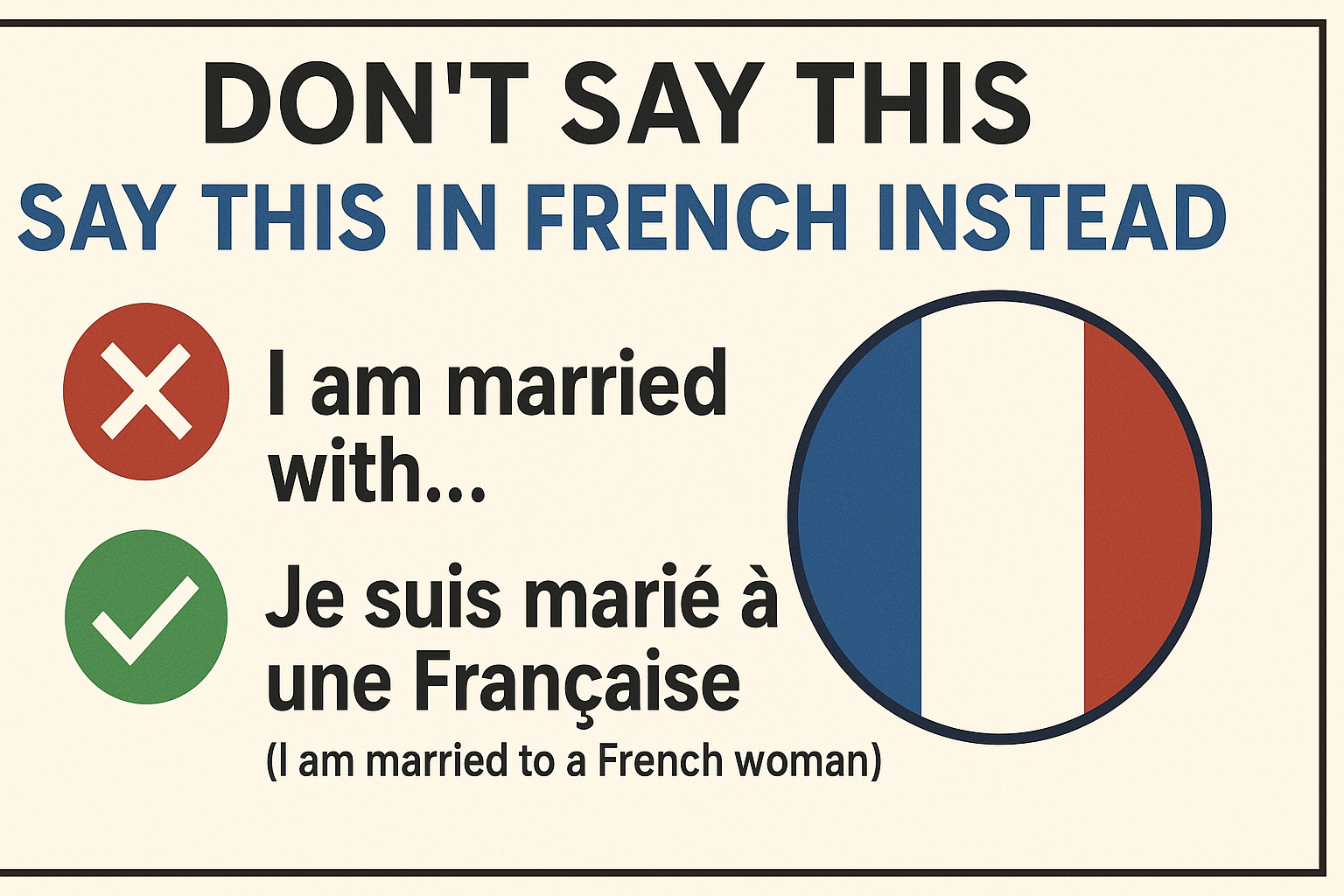
6. Don’t say: “I am married with…”
❌ Je suis marié avec
✅ Je suis marié à
French uses à, not avec, when talking about marriage.
✔ Example:
Je suis marié à une Française.
(I am married to a French woman.)
This rule applies in both spoken and written French.
7. Don’t say: “I assist a meeting”
❌ J’assiste une réunion
✅ J’assiste à une réunion / Je participe à une réunion
The verb assister in French means to attend, but it requires à.
✔ Example:
J’assiste à une réunion importante.
Never use it without the preposition.
8. Don’t say: “I demand you”
❌ Je te demande (means “I ask you”)
✅ Je te demande de…
In French, demander means to ask, not to demand.
✔ Example:
Je te demande de m’aider.
(I ask you to help me.)
To express demand, French uses exiger.
9. Don’t say: “Actually”
❌ Actuellement (means currently)
✅ En fait
This is a classic false friend.
✔ Examples:
- En fait, je ne suis pas d’accord. (Actually, I don’t agree.)
- Actuellement, je travaille à Lyon. (Currently, I work in Lyon.)
Mixing these changes meaning completely.
10. Don’t say: “I pass an exam”
❌ Je passe un examen (context-dependent)
✅ Je passe un examen / Je réussis un examen
In French:
- passer un examen = to take an exam
- réussir un examen = to pass (succeed)
✔ Example:
J’ai réussi mon examen.
(I passed my exam.)
Conclusion
Learning French is not just about vocabulary or grammar — it’s about thinking in French. These common English-to-French mistakes can instantly reveal a non-native speaker. By replacing literal translations with authentic French expressions, your spoken and written French will sound smoother, more confident, and culturally accurate.
Practice these phrases regularly, listen to native speakers, and always remember: good French is not translated French — it is French-style French.